YouTube Transcript: Three AI Services Went Down Simultaneously — My 5090 Saved Me

Disclaimer: This post is machine-translated from the original Chinese article: https://ai-coding.wiselychen.com/youtube-ai-outage-5090-hybrid-transcript/
The original work is written in Chinese; the English version is translated by AI.
Translation Note
This article is translated from the Chinese original. The author writes primarily in Traditional Chinese, and the original version is the canonical source — including the latest updates, comments, and follow-up discussions.
Read the Chinese original: YouTube 逐字稿:三家 AI 同時掛了,我的 5090 救了我
If you spot any translation errors or have feedback, please refer to the Chinese version as the source of truth.
Author: Wisely Chen Date: September 2026 Series: AI Coding Field Notes — YouTube Transcript Keywords: AI outage, fault domain, Colossus 1, Anthropic, hybrid cloud, 5090, Qwen 3.8 27B, BCP, fault tolerance, sovereign AI
What This Episode Is About
On September 3, Claude and Grok went down almost simultaneously. ChatGPT followed about an hour later. Codex and Cursor became unusable too — three full hours of downtime. The root cause was a failure at the Memphis Colossus 1 data center. Anthropic had leased the entire facility back in May, sharing the same fault domain as Grok. ChatGPT was overwhelmed by the resulting traffic tsunami. This episode covers three cognitive shifts from this incident: multi-vendor strategy doesn’t equal multi-fault-domain strategy, an on-prem 5090 became the last line of defense, and hybrid cloud is now a necessary architectural choice.
Length: ~10 minutes
Timestamps
- 0:00 Three AI services went down at once
- 0:55 What actually happened: Memphis Colossus 1
- 2:05 Timeline analysis: Claude → Grok → ChatGPT
- 3:25 Traffic tsunami overwhelmed ChatGPT
- 3:45 Our AI infra is actually very fragile
- 4:55 BCP that only bets on cloud is a big gamble
- 5:25 Infra is already a chain of fire ships
- 5:35 My 5090 + Qwen 3.8 27B held the line
- 5:58 Hybrid cloud is the real backup
- 7:05 Not just data security, not just token savings — it’s resilience
- 8:07 Why no cross-region failover?
- 9:10 Conclusion: Start with an 80/20 on-prem allocation
- 10:00 What tools I used to make this video
Below is the full transcript of the video, corrected and organized into sections.
Opening — Three AI Services Went Down at Once
Hey everyone. Today I’m not talking about how powerful ChatGPT Ultra is, or how great Fable 5.1 is. What I want to talk about is something that happened on Thursday evening Taiwan time — a pretty significant incident. At that point, Claude and Grok became unreachable almost simultaneously, and then about an hour later ChatGPT and Codex went down too.
Some people speculated it might be a nation-state cyberattack targeting American AI services — but that’s a bit too conspiracy-theory. Another theory was Cloudflare, since they also had a minor issue around the same time. But Cloudflare came out very firmly saying it wasn’t their fault. When a publicly traded company makes that kind of definitive statement, it usually means they’re pretty confident. So we can rule that out.
Probable Cause — Memphis Colossus 1
Now let’s talk about the most likely cause. It’s still unconfirmed, but it’s a highly plausible hypothesis. Back in May, as everyone knows, SpaceX leased their Colossus 1 — originally built for Grok — to Anthropic. The reason was that they had already built Colossus 2, so Colossus 1’s utilization was lower, and they rented it to Anthropic, which was desperate for compute at the time.
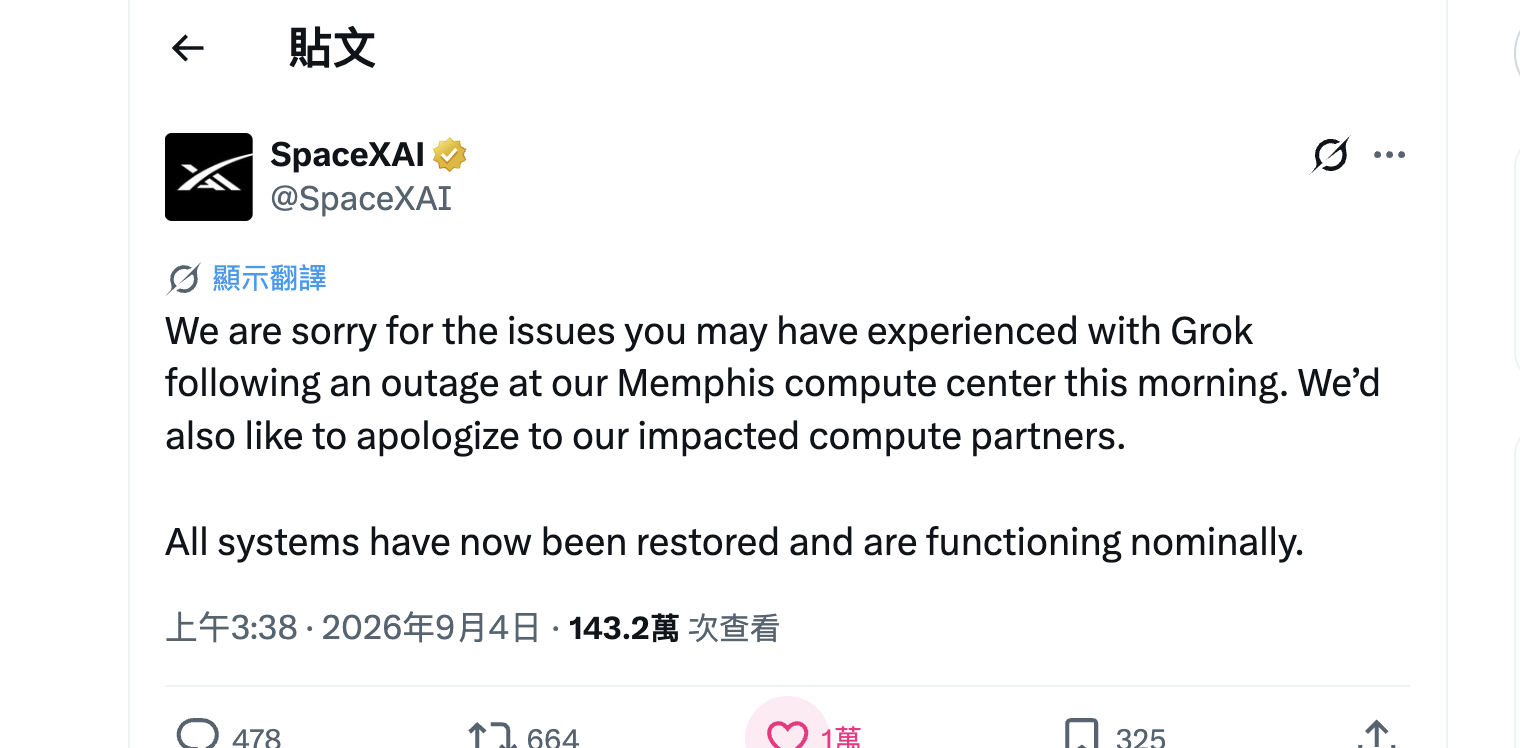
So we know that Anthropic and SpaceX actually have overlapping infrastructure. And at the time of the incident, SpaceX did come out and confirm that they had issues at their Memphis Colossus 1. They posted on X apologizing to their affected compute partners.
If Colossus 1 in Memphis had a problem, Claude would naturally be affected too. Looking at the timeline, Claude went down first, and Grok followed just 4 minutes later.
Timeline Analysis — The Same Domino
So we can pretty confidently conclude that because SpaceX reported Memphis issues, combined with the publicly known lease agreement, and the fact that these two services went down within minutes of each other — the Memphis Colossus 1 failure caused both Claude and Grok to go down simultaneously.
As for why ChatGPT went down an hour later — that’s less directly related to Memphis. But we can reasonably infer what happened. It was daytime in the US, meaning heavy usage was already underway. On top of that, agents worldwide were making API calls around the clock. When people and agents discovered that Claude and Grok were down, they all switched to the next best option — OpenAI.
That massive traffic surge likely overwhelmed ChatGPT. OpenAI later said the issue was a “routing error,” but the timing was too close. It’s much more likely that the traffic tsunami knocked them out.
The exact root cause doesn’t matter that much for us — we’re not employees at these companies, so we can’t do a proper postmortem. But what I really want to say is: our AI infrastructure is genuinely fragile.
Cognitive Shift 1 — Multi-Vendor Doesn’t Mean Multi-Fault-Domain
Let me break this into two parts. First: when we used to design BCP or fault tolerance for AI, we’d think “I’ll subscribe to two providers — Claude and OpenAI — so if one goes down, I’ve got the other.” And since Grok has gotten quite capable, I personally also use it for some of my work.
But for the first time, we discovered that even when you spread your risk across multiple providers, their infrastructure can still be interconnected. They’re not physically isolated. And even if they were truly physically isolated, AI demand is so intense right now that when one major provider goes down, the spillover demand alone can overwhelm the others’ already-stretched compute capacity.
So the takeaway is: if your BCP or backup strategy only focuses on cloud providers, that’s actually a pretty big bet right now. This incident showed us clearly — you can’t define your BCP as “subscribe to multiple cloud providers,” because multiple cloud providers can absolutely go down at the same time. The current infra landscape is like a chain of fire ships — one goes, they all go.
Cognitive Shift 2 — The 5090 Became the Last Line of Defense
The second thing I noticed — and I experienced this firsthand — is that even though I subscribe to Codex, Claude, and Grok simultaneously, the only thing that kept running when everything went dark was my own 5090 with Qwen 3.8 27B.
This tells us that if enterprises genuinely want robust failover, the thinking has to go beyond multiple cloud providers. We need to consider hybrid cloud. First, because multiple cloud providers might share the same underlying infrastructure. Second, because the cascade effect and traffic tsunamis can take down providers that weren’t originally affected.
When you have an on-prem server where you fully control the traffic — it can handle your day-to-day tasks. Sure, it might not match cloud performance on frontier-level work, but it can survive the critical window when everything else is down, keeping your AI-dependent workloads alive. That’s its real value. And let’s be honest: today’s on-prem AI models can genuinely get work done.
Cognitive Shift 3 — Hybrid Cloud Is About Resilience, Not Just Cost
So from now on, hybrid cloud isn’t just a data security play, and it’s not just about saving on token costs. After this incident, it’s clear that for maintaining architectural resilience and stability, hybrid cloud has become a necessary path.
I personally felt a real sense of relief because I had pre-invested in a 5090. I was able to switch almost everything over to it — a bit slower, sure, but I could still move. During those three hours, if you didn’t have that kind of reserve on hand, your only options were subscribing to Chinese API services, some niche API providers, or the much-maligned Gemini. Otherwise, you were basically stuck.
Why No Cross-Region Failover?
Honestly, what surprised me most is this: with thousands upon thousands of servers, standard cloud infra shouldn’t have a single issue take down an entire data center. But it did — and it took down essentially the company’s entire service. Don’t they have failover to different regions? Can’t they route around Memphis when it goes down? That part is genuinely puzzling.
I understand that Anthropic and OpenAI are still startups, so enterprise-grade cross-region redundancy is naturally weaker. That’s understandable. But think about it — the entire world has bet everything on these few companies. That’s a sobering reality.
Conclusion — Start with an 80/20 On-Prem Allocation
So the bottom line: hybrid cloud is now a necessity, especially for enterprises. Take some time to think about how to configure your on-prem capacity. Start with an 80/20 or 90/10 split — you need at least 10-20% of your compute under your own control. Then gradually adjust your workloads until you reach 50/50, or eventually even 30/70. That’s the direction we should be heading.
What Tools I Used to Make This Video
One more thing — for this video’s visuals, I used to rely on Grok or Sora, but this time I used MiniMax H3 running on my 5090, combined with ChatGPT’s Codex Image Gen 2. The results are actually quite good. Going forward, I’m going to try building an automated workflow to make my YouTube production even richer.
That’s it for today. Thanks everyone.