YouTube Transcript: Two Days with Qwen3.8-27B — RTX 5090 SGLang / vLLM / llama.cpp Benchmarks
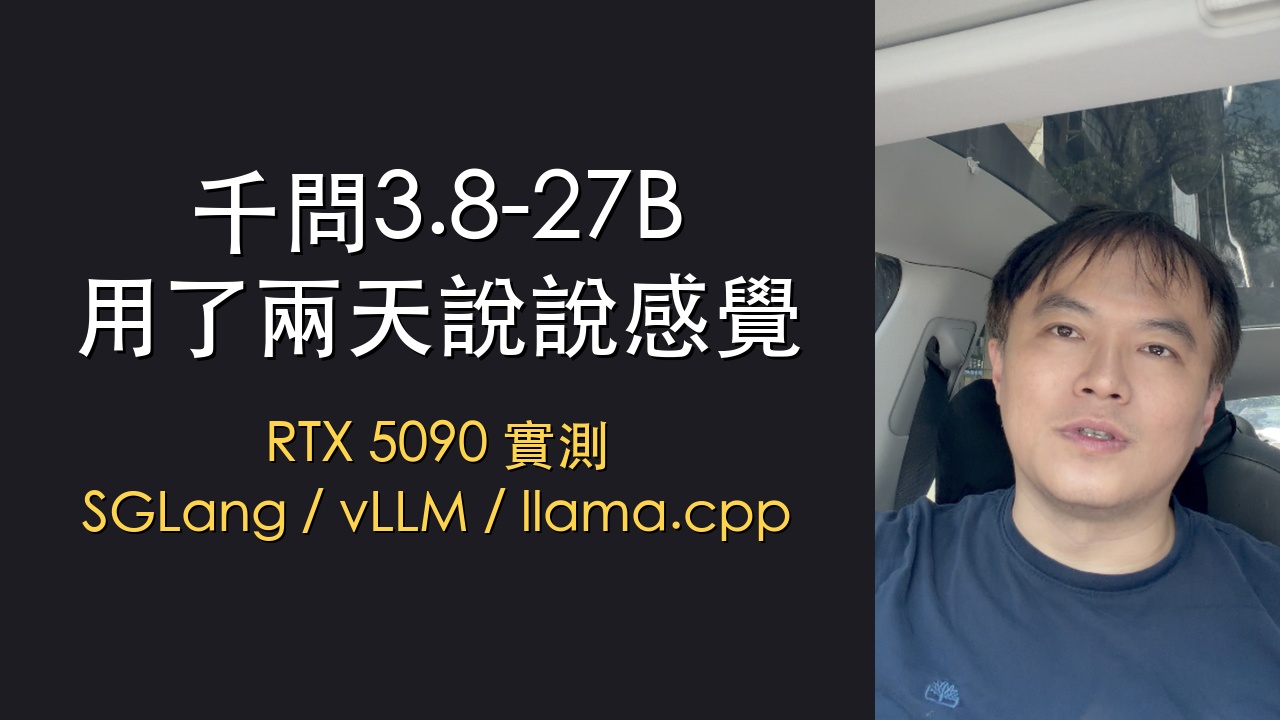
Disclaimer: This post is machine-translated from the original Chinese article: https://ai-coding.wiselychen.com/youtube-qwen38-27b-rtx5090-sglang-vllm-mtp-transcript/
The original work is written in Chinese; the English version is translated by AI.
Translation Note
This article is translated from the Chinese original. The author writes primarily in Traditional Chinese, and the original version is the canonical source — including the latest updates, comments, and follow-up discussions.
Read the Chinese original: YouTube 逐字稿:千問3.8-27B 用了兩天說說感覺——RTX 5090 SGLang/vLLM/llama.cpp 實測
If you spot any translation errors or have feedback, please refer to the Chinese version as the source of truth.
Author: Wisely Chen Date: August 2026 Series: AI Coding Field Notes — YouTube Transcripts Keywords: Qwen3.8-27B, RTX 5090, SGLang, vLLM, MTP, Speculative Decoding, NVFP4, local LLM, KV cache, cloud-local hybrid
What This Episode Covers
Two days ago Qwen3.8-27B went open weights, with official benchmarks showing SWE-bench Pro 61.7 — beating Opus 4.6 Max’s 53.4. Those benchmarks are Alibaba’s. This episode is about mine: I put the model on a 32GB RTX 5090, ran SGLang and vLLM each through a full round of testing, and answered one very practical question — how many people can a single consumer card actually feed?
The answer: four people, 425 tok/s total throughput, roughly 106 tok/s each. MTP is a free lunch: vLLM with MTP-2 is 73.5% faster single-user — but the same MTP on the llama.cpp route only gains 20%, and this episode cross-references a community GGUF test on that. All launch parameters are in this post.
Length: ~17 minutes
Timestamps
- 0:00 Opening: Qwen3.8-27B release background
- 2:07 SWE-bench Pro 61.7 beats Opus 4.6 Max; architecture carries over from 3.6
- 5:33 Hands-on coding impressions: harness impact > model impact
- 7:01 Test environment: SGLang / vLLM / llama.cpp
- 7:35 Why NVFP4? Community says 1-5% quality drop
- 8:25 vLLM + MTP testing
- 9:09 The 4-user concurrency sweet spot: ~106 tok/s each
- 10:17 SGLang vs vLLM framework differences
- 10:46 A local model at 90% of Opus 4.6’s capability
- 11:45 DeepSeek V4 Flash + DGX Spark comparison
- 14:57 Cloud-local hybrid deployment architecture
- 17:07 Closing: unbeatable below consumer GPU tier, trades blows with cloud
Full Transcript
Opening
Hi everyone, back again this week.
Two days ago Qwen3.8-27B went open weights. I wrote a benchmark breakdown on the blog: SWE-bench Pro 61.7, beating Opus 4.6 Max’s 53.4. Those are the official numbers — today is about my numbers. Yesterday I put it on my 32GB RTX 5090 and ran SGLang and vLLM each through a round of testing. The question is simple: how many people can this card serve at the same time?
Environment: Squeezing It into 32GB with NVFP4
The model is RadixArk’s Qwen3.8-27B-NVFP4 quantized build — 27B is the only way it fits in 32GB — running SGLang with MTP speculative decoding, generating 2 draft tokens at a time.
Why be this stingy about every megabyte? Because it’s a dense model. Someone in the community ran the math: DeepSeek V4 Flash has 284B parameters but only activates 13 billion per token; this 27B puts every parameter on the field for every single token, so the actual compute per token is more than double V4 Flash’s. Dense model speed doesn’t come free — you have to engineer it out. Once running, the GPU is down to 1.2GB free, and every other service has to shut down first.
Single User: 113.75 tok/s
Single-user test: SGLang averages 113.75 tok/s. You simply cannot read as fast as it outputs. The control group: same model, running on a 96GB unified-memory MacBook, a community tester got only 5 tokens per second. Fitting in memory is not the same as actually running.
But a whole 5090 for one person is a bit of a waste. The real point is the next round.
Four Users Concurrent: This Card’s Sweet Spot
Four people come in at once, each generating 2,048 tokens: everything finishes in 19 seconds, total throughput 425.44 tok/s, each person getting 106 to 108.
Four people using it simultaneously, and each one gets nearly the same speed as running solo. Single user 113, four users 106 each, nobody queuing. That’s the sweet spot.
Eight Users: Orders Accepted, Kitchen Overwhelmed
So I got greedy and went to eight. All eight requests completed, but total time was 54 seconds and throughput dropped to 303 — lower than the 4-user run. Completion times split visibly into three waves: 18 seconds, 37 seconds, 54 seconds. The KV pool ran out; only 3-4 people were actually generating at any moment while the rest queued. You can take eight orders — you just can’t cook for eight people.
vLLM and MTP: One Launch Flag, 73.5% Difference
Same model, moved to vLLM. First, a pothole: version 0.20.2 fails to load with an lm_head.input_scale error; upgrading to 0.27.1 fixes it.
A/B/C test where the only variable is MTP: without it, single user gets 57.83 tok/s; with MTP-2, 100.33. That’s 73.5% faster single-user and 67.2% more total throughput at four users — from one line in the launch command.
But this gain depends heavily on your framework. A community tester went the llama.cpp/GGUF route on the same 5090: MTP only gained 20% on short context, and actually slowed things down past 100K context. His conclusion was “MTP doesn’t do much on a 5090.” Same MTP head — native serving implementation gets 73%, llama.cpp gets 20% and sometimes goes negative. Whether MTP works is not a question for the model. It’s a question of how well your framework implements it.
SGLang vs vLLM
Both running MTP-2: SGLang does 425 at four users, vLLM does 351 — 17% lower. If you’re chasing raw speed, pick SGLang. If your ecosystem lives on vLLM, vLLM is fine — what I’m running in production right now is exactly the vLLM MTP-2 four-user configuration.
One more community observation: someone rented a 96GB RTX Pro 6000 to run vLLM with full BF16 weights and found single-user inference barely faster than much cheaper machines. That’s because vLLM cares about throughput, not single-stream latency. The value of these serving frameworks is redeemed through concurrency — complain about single-user speed and you’re missing the point; put four people on it and it pays for itself.
Reality Check
Three things I have to say honestly. First, the SGLang tests used 2,048 tokens per person while vLLM used 512 — not a strict A/B, so treat the trends as comparable but don’t memorize the percentages as gospel. Second, this is short-output throughput testing, not an agent workload, and radix cache was off — multi-agent long-context scenarios need separate testing. Third, I tested the quantized build — a community comparison found the Q5 quantized version produced buggy frontend code while the BF16 full-precision build was clean. This episode answers speed, not quality.
Conclusion
One 32GB RTX 5090 is a model server for a four-person team, 106 tok/s each, with an experience barely distinguishable from having the card to yourself. MTP must be on — leaving it off means being 40%+ slower for nothing. And don’t get greedy: eight users just makes everyone queue together. The KV pool is the 32GB ceiling.
Two days ago the story was that local deployment is no longer a compromise on benchmarks. Today it lands in serving numbers: the model is strong enough, the card fits it, and four people can use it smoothly. All three launch configurations are below — take them and run.
How It Feels After Two Days
Honestly, I’m not sure why Alibaba is doing this, and I can’t quite see through the business model either. But they keep throwing high-intelligence models that run on consumer GPUs out as open weights, and for the community — for a lot of people — that genuinely helps.
I’ve spent these two days very happily testing Qwen3.8-27B nonstop. Cloud models are strong today and might suddenly get nerfed tomorrow — you don’t control the guardrails, the compute, or the pricing. Local gives you a different kind of stability: no guardrails, fixed hardware, predictable output. These two aren’t mutually exclusive — they genuinely complement each other. Routine agentic automation runs local, and with 3.8-27B’s intelligence now able to catch complex tasks too, a lot of work can move down from the cloud.
One-sentence verdict: Qwen3.8-27B — unbeatable below the consumer GPU tier, trades blows one-for-one above it with cloud models. Also looking forward to Qwen3.8-35B, hopefully soon.
That’s all for today. Thank you, everyone.
Appendix: Full Test Data
Test Environment
- GPU: NVIDIA RTX 5090, 32GB VRAM
- Model: RadixArk/Qwen3.8-27B-NVFP4 (4-bit quantization, Blackwell hardware acceleration)
- GPU usage: ~30,825 MiB / 32,768 MiB (1,284 MiB free — Whisper/embeddings/ComfyUI must be stopped)
- vLLM version: 0.27.1 + PyTorch 2.13.0+cu130 + FlashInfer 0.6.16.post3 (0.20.2 fails to load with
lm_head.input_scaleerror)
SGLang Results
| Scenario | Output/User | Completion Time | Total Throughput | Per-User Throughput | MTP Acceptance | Token Pool |
|---|---|---|---|---|---|---|
| Single user | 512 tokens ×3 | ~4.5s/run | 113.75 tok/s | 113.75 tok/s | 78–88% | — |
| 4 concurrent | 2,048 tokens | 19.255s | 425.44 tok/s | 106.37–108.62 | 80–91% | ~64,079 |
| 8 concurrent | 2,048 tokens | ~54s (3 waves: 18s/37s/54s) | 303.4 tok/s | — | — | ~7,703 |
vLLM A/B/C Test (MTP comparison, 512 tokens per user)
| Config | Single-User tok/s | 4-User Total tok/s | vs No MTP (1U) | vs No MTP (4U) |
|---|---|---|---|---|
| No MTP | 57.83 | 210.37 | — | — |
| MTP-1 | 85.63 | 305.09 | +48.1% | +45.1% |
| MTP-2 | 100.33 | 351.71 | +73.5% | +67.2% |
MTP-2 draft acceptance: ~69% average (first draft token 79–80%, second 58–59%, mean accepted length 2.38–2.39).
SGLang vs vLLM (both MTP-2)
| Framework | Single-User tok/s | 4-User Total tok/s | Note |
|---|---|---|---|
| SGLang | 113.75 | 425.44 | 4-user test at 2,048 tokens/user |
| vLLM | 100.33 | 351.71 | 4-user test at 512 tokens/user |
| Gap | vLLM 11.8% lower | vLLM 17.3% lower | Different test conditions; trends comparable |
Appendix: Three Launch Configurations
SGLang, 4 users (recommended)
1
2
3
4
5
6
7
8
9
10
11
12
13
14
15
16
17
18
sglang serve \
  --trust-remote-code \
  --model-path RadixArk/Qwen3.8-27B-NVFP4 \
  --mem-fraction-static 0.98 \
  --attention-backend flashinfer \
  --chunked-prefill-size 2048 \
  --reasoning-parser qwen3 \
  --tool-call-parser qwen3_coder \
  --mamba-full-memory-ratio 4.59 \
  --host 0.0.0.0 \
  --port 30000 \
  --max-running-requests 4 \
  --speculative-algorithm NEXTN \
  --speculative-num-steps 1 \
  --speculative-eagle-topk 1 \
  --speculative-num-draft-tokens 2 \
  --cuda-graph-max-bs-decode 4 \
  --disable-radix-cache
SGLang, 8 users (accepts more orders; long outputs get batched)
Same as above with two changes: --max-running-requests 8 and --cuda-graph-max-bs-decode 8.
vLLM MTP-2 (0.27.1, currently running in production)
1
2
3
4
5
6
7
8
9
10
11
12
13
14
vllm serve RadixArk/Qwen3.8-27B-NVFP4 \
  --trust-remote-code \
  --served-model-name Qwen3.8-27B \
  --host 0.0.0.0 \
  --port 30000 \
  --gpu-memory-utilization 0.95 \
  --max-model-len 32768 \
  --max-num-seqs 4 \
  --max-num-batched-tokens 8192 \
  --attention-backend FLASHINFER \
  --reasoning-parser qwen3 \
  --enable-auto-tool-choice \
  --tool-call-parser qwen3_coder \
  --speculative-config '{"method":"mtp","num_speculative_tokens":2}'
Further Reading
- Qwen3.8-27B Open Weights: SWE-bench Pro 61.7 Beats Opus 4.6 Max — ‘Just Use On-Prem’ Is No Longer a Compromise
- Gemma 4’s 3x Speedup: Speculative Decoding Isn’t New, But Google Shipped the Whole Drafter as Apache 2.0 (Chinese)
- Running GLM 5.2 on a Single Machine: RTX Pro 6000 and the Hunt for Cost-Effective Tier-1 Local Models (Chinese)
- RTX 5090 Price Up 70% in Three Months: Five Technical Paths to Lower the Local AI Hardware Bar (Chinese)
- GPU Prices Up Yesterday, DeepSeek API Up Today — Cloud-Local Hybrid as a Hedge (Chinese)